


TURNING PAIN INTO PURPOSE:
THE LIFE AND LEGACY OF JAVED AHMAD TAK
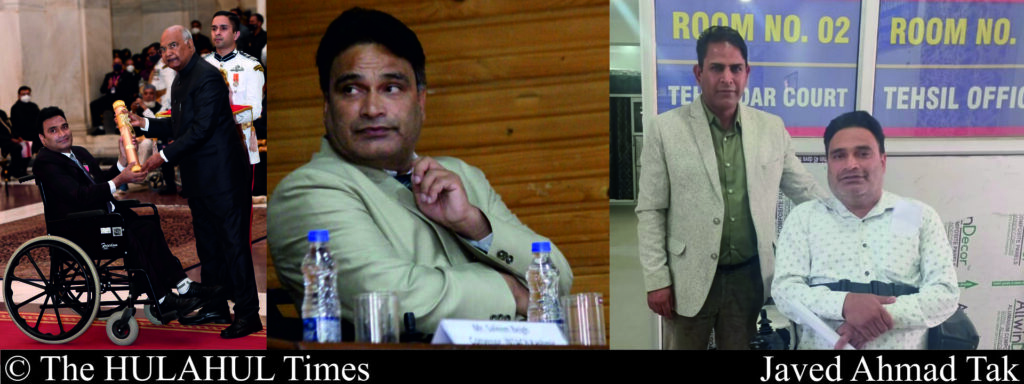
“It is not the disabled person who is tested by the almighty, it is the test of ‘abled persons’ how they treat the person with disability.”
-Javed Ahmad Tak
In an interview with The HULAHUL Times, Mr. Javed Ahmad Tak spoke with a voice that exuded calm composure, deep humility, and a profound sense of gratitude towards life. Javed Ahmad Tak is a prominent Disability Rights Activist and social worker from Jammu and Kashmir. He has dedicated his life to creating a barrier-free environment and securing the right to education for children with disabilities in the region. In 2020, he received the Padma Shri award for his unwavering commitment to empowering persons with disabilities and his crucial advocacy work.
While sharing the incident that became the turning point of his life, Mr. Javed called the initial phase “life in a custody.” In 1997 he became a paraplegic and wheel chair-bound after being shot in the spine during an armed conflict in Kashmir. Despite this, he didn’t give up and navigated his “dependent life in an independent way.”
When asked, what does this phrase “dependent life in an independent way” signify to him Mr. Javed confidently articulated that everything has a value, even a stone has a value of itself. He explained that a dependent person is surrounded by an independent sphere. Everyone possesses some capabilities, even a person with severe intellectual disability has some distinct abilities. Its cultivation requires first identification, then it’s use and, then with correct intervention, it can lead to significant contributions, aiding to lead an independent way of life.
While sharing the inspirational story of his life Mr. Javed began with how challenging his life was during the immediate years of his injury. He described that his whole family was hampered because of his immobility. Moreover, his surgeon remarked that his injury would take 10 to 12 years to recover and sometimes spinal injuries are impossible to be recovered. In such circumstances, Mr. Javed wanted to divert his mind and started providing free tuitions to the children in locality. This was a delightful experience for him to connecting with the children, as he started going out on his wheelchair with his students and remained updated with what’s going around.
After 4 years, he developed much experience about disability. And one day, while pondering, he realized there were no students with disabilities, and thought do children with disabilities not aspire to receive education? Travelling through the oceans of questions, his ship of mind anchored on a solution – a Census. In order to gather information about the persons with disabilities Mr. Javed conducted a Census in the nearby areas and found that children with disabilities were living in a miserable condition; many were tied by their family members because of their harsh behavior. After the census, Mr. Javed was determined to provide education to children with disabilities and established a Centre, Humanity Welfare Organization Helpline in 2003, which is operating at a huge level today.
In order to fund the initial financial requirements of Humanity Welfare Organization Helpline Mr. Javed used his personal ex-gratia relief of Rs. 75000. When asked what motivated him to use his personal ex-gratia relief, he replied, in those times persons with disabilities were not in any account. When he took the decision to educate the persons with disabilities nobody trusted him, and questioned his intentions. Also, he could not ask his father to financially support his mission as he already lost a huge amount of money for his treatment. After denying the ex- gratia relief for 5 years, he finally uncashed the cheque and used it for funding the financial needs of Humanity Welfare Organization Helpline. Mr. Javed admirably explained that it was not just 75000 rupees, it was like crores. As it paved the way for economic independence. Mr. Javed describe that nothing is possible without resources, even if it is, it will take a lot of time, will-power and self-belief.
Delineating about the initial organizational obstacles that came in his way of social welfare, Mr. Javed remembered that at that time, militancy was at its peak in Jammu and Kashmir. It took him 3 years to collect the NOC (No Objection Certificate) for establishing his organization. He had to visit countless offices on wheelchair just to collect an NOC, as there was a sheer lack of acceptance among people and no one trusted his intentions. Sceptics argued that he was going to establish his own business. Furthermore, prevailing stereotypes among local community members created a reluctance to enroll their children in schools exclusively for students with disabilities. They feared their child would be stigmatized by attending such an institution.
And, the biggest challenge was sheer lack of resources. Mr. Javed described how he had to knock every possible door on wheelchair; just to ask for some financial support. However, he mentioned, at the end of the day there was a sense of satisfaction when he was able to collect some money. Upon collection of some amount of money he used to think what next, he was going to buy for the children, like stationery, physiotherapy tools and other equipment. Mr. Javed explained that there were all kinds of challenges socio-economic to administrative. Such experiences of him highlight the failure of a society in supporting a person who selflessly wanted to work for the development of the community.
With the passage of time, Mr. Javed overcame challenges and established the Humanity Welfare Organization Helpline, a successful organization dedicated to empowering persons with disabilities, helping them secure a better future, and providing an independent life. The organization, which offers comprehensive facilities and an appropriate environment, also includes the Zaiba Aapa Institute for Inclusive Education. Mr. Javed’s original vision for the institute was “to create a Centre which could be replicated as a model.” The school is named in tribute to his late grandmother, Zaiba. She was known as Zaiba Aapa among her family members and neighbors. Mr. Javed mentioned she was a social worker herself and worked for the community.
While narrating the stories of his grandmother, Mr. Javed explained that how in winters when Kashmir was covered with ice, she used to make healing ointment with the help of collected medicinal herbs and personally apply it on the wounds of the affected persons. She was a kind of local nurse, a delivery facilitator. Once she helped in the first delivery of an army men’s wife who lived near the mountains. She was afraid that who will take care of her newborn as she was completely unaware of post-delivery precautions. It was Zaiba Aapa who went there to facilitate her delivery and massaged her child with oil. Beyond her medical service, Zaiba Aapa was known for her boundless generosity, cooking for and providing food to students, neighbors, travelers, and the needy, earning the reputation that whoever sought food should simply “go to Zaiba Aapa, she will feed.”
Mr. Javed remarked that he found it best to name the school after her grandmother, as she was a social worker herself. It was the best tribute for her. Zaiba Aapa Institute for Inclusive Education was the first school of its kind, to get registered exclusively for persons with disabilities.
As part of his advocacy work, Mr. Javed introduced many reforms in the Kashmir University. As the infrastructure was not persons with disabilities friendly. With the efforts of Mr. Javed, the university became barrier-free for persons with disabilities as construction of ramp, disabled friendly washrooms and other facilities were installed. While describing the biggest challenges faced during these reforms, he declared that the students with disabilities themselves did not know their own rights and the separate UGC guidelines for them. He had to search everything, designed University and gave proposal to the Vice Chancellor for the ramification of the university.
Mr. Javed said that he suggested the Vice Chancellor to celebrate the World Disability Day in the Kashmir University. However, when the first World Disability Day was to be celebrated in the premises, only 13 students came. But with the support of students of other departments the event became a success. Now, years later, the same program is organized for 2 days in Kashmir University, that too with national and international type of workshops.
When asked what changes or influence he encountered on his work and his broader disability rights movement after receiving the Padma Shri award, Mr. Javed announced that the credibility and the trust of people got enhanced. Also, now people are more sensitized in the region with increased awareness. And the number of students also got doubled; earlier there were around 140 students, today around 280 students are enrolled.
Other than Padma Shri what is your personal or professional achievement that is closest to your heart? Mr. Javed replied to this question that it is his students who are closest to his heart. Illuminating the success of his students, Mr. Javed mentioned of Saima Hussain and Zakia Mansur. Zakia is a girl with complete blindness and she was rejected from the school when she was 9 years old. His parents brought her to Humanity Welfare Organization Helpline, explaining that she bothered them to attend the school but she could not. They said they will bring her everyday so that she can learn something there. Mr. Javed proudly stated that Zakia is currently pursuing Masters in History from Jawaharlal Nehru University and conducting research there. On the other hand, Saima has become a Junior Artist in Calcutta Academy and she has qualified NET examination. He described that many girls with complete speech and hearing impairment now have opted for higher education and are studying in colleges and Universities. Additionally, an intellectually disabled girl is now married and living her life happily.
Talking about the biggest misconception about persons with disabilities, Mr. Javed answered that there are several misconceptions including underestimation of capabilities of persons with disabilities, the perception that they cannot play sports, the prejudice that they cannot maintain a family, they cannot marry etc. They are not allowed to claim property rights. Mr. Javed pronounced that researches claim that persons with disabilities concentrate more on their work as compared to “able bodied.” So, when a person with disability is employed, they are more productive as they do not get distracted easily.
Mr. Javed believe that mainstream teachers should be given training in special education. He said “disability is a term between dependence and interdependence.” And, passionately elaborated “it is not the disabled person who is tested by the, almighty it is the test of the ‘abled persons’ how they treat the persons who have some bodily challenges.” He argues “if a teacher is not able to give judicious education to every student who comes to his class, then it is the teacher who is disabled not the student.” Also, creation of special educators or teachers isolates the disability sector and restricts their inclusion. “Therefore, every teacher should be known to special education, every teacher should have the ability to deal with students with disability.”
While throwing light on the major challenges that are prevailing in the region for persons with disabilities Mr. Javed listed lack of accessibility, lack of special educators and teaching materials, especially at higher educational levels. Also, many a times family is not supportive. The house itself has to be accessible first. He defined “when discrimination starts from the homes it never ends.”
In his message to young individuals Mr. Javed said “you should never give up and never die while living.”
Javed Ahmad Tak’s journey is a powerful call to action, reminding us his core message that it is the ‘abled persons’ who are truly tested. Having transformed his personal pain into purpose, he proved that the greatest barriers are not physical, but systemic and societal. As we witness the independent successes of his students, his life is evident of nothing is impossible with true resilience and enduring will-power. Mr. Javed has not just built an institution; he has built a model for an actually inclusive society, urging to end discrimination in all its forms.

Hands United for Lifelong Aid and
Human
Upliftment Lever Foundation
Since 2012
ALL CONTACTS
-
Registered Office:
1/5 Parel Shivshandesh CHSL., Kasturba Gandhi Nagar, LR Papan Marg, Worli, Mumbai 400018. -
Branches:
Worli, Charni Road, Kalyan, Pune - +91-8082376061 , +91-8369001611
- hulahulgrp@gmail.com
SUPPORT US
If you wish to contribute to our mission, you can make a donation via bank transfer to the following account:
Bank Details
Name: HULAHUL Foundation
Bank: IDBI Bank
Account Number: 0026104000273299
IFSC Code: IBKL0000026
Branch: Prabhadevi
Leave a Reply