


AMLA RUIA:
THE WOMAN WHO MADE WATER A REVOLUTION, NOT A RESOURCE
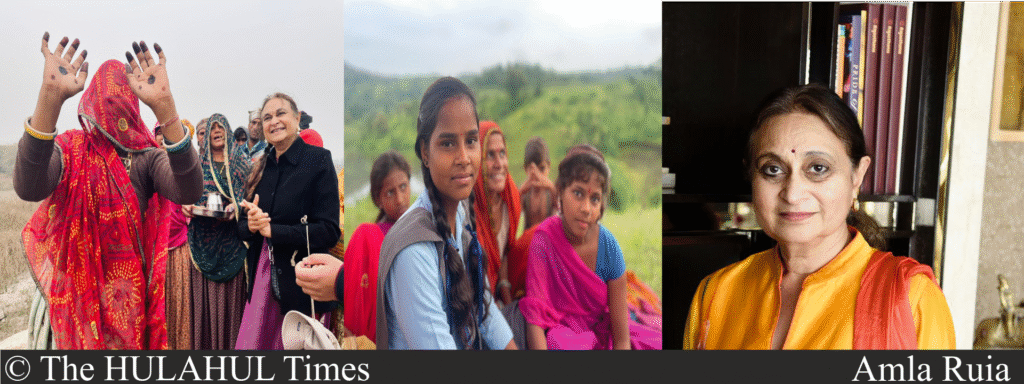
The story of Aakar Charitable Trust is not just a tale of concrete and water; it is a profound testament to the power of resolve and the deep conviction that, where there is a problem, a solution must exist. The woman at the heart of this movement, is Ms. Amla Ruia, often revered as the ‘Water Mother of India,’ began her journey not with a master plan, but with a deeply felt emotional response to suffering.
The year was 1998, and Rajasthan was grappling with a brutal famine. The images of distress, published in the media, struck Ms. Amla Ruia at her heart. For someone always inclined to serve her country and do something truly worthwhile, these pictures were a call to action she could not ignore. It was unacceptable for her to see “brothers and sisters” in rural areas, the very farmers who provide food for every plate, living in absolute poverty and indignity.
While her well-to-do family initially responded with immediate relief, sending lorries of food and tankers of water to the affected areas, she recognized that this was merely a temporary fix. It was not the cure for the recurring cycle of droughts and famines that plagued many parts of the country year after year. Despite admitting that the challenge at hand covered almost all of India, she was determined that “if there is a problem, there is a solution.”
Driven by this burning passion, the lone housewife set aside her privileged background and stood firmly by her resolution to find a permanent fix. Nothing, not her social standing nor the sheer scale of the crisis, could stand in the way of her plan for social service.
To illustrate the methodology behind Aakar Charitable Trust’s noble work of rainwater harvesting, one need look no further than the organization’s very first check dam, built in Mundawara Village, Rajasthan, in 2006.
Ms. Amla Ruia recalled upon arriving at Mundawara, the then two-member team of Aakar Charitable Trust found a village in dire situation. The soil was completely degraded, and water was non-existent. Most able-bodied men had departed for urban areas in search of a livelihood, leaving behind only the elderly and infirm. Aakar Charitable Trust‘s approach was immediate and collaborative; they intermingled with the remaining residents, asking them what they believed would solve their problem.
The villagers rallied together, proposing the construction of a rainwater harvesting structure. This demonstrated a crucial insight, even in arid regions like Rajasthan, particularly in the suitable terrain of Udaipur Tehsil, the local people were aware of the potential for dam construction. The Trust, though small, was ready. They promised to stand solidly behind the villagers, providing all the funds raised and all the necessary expertise, sorting out every problem that arose during construction.
The Panchayat gave its consent, but the most difficult part of the arrangement was to asking the villagers to contribute one-third of the total cost of construction. Given their extremely impoverish economic condition, this seemed impossible. The team, however, recognized that true empowerment lay in contribution, umplanting in the villagers a sense of ownership and value. A dedicated team went from family to family, understanding each person’s situation and stressing that this was a collective work, a project that would benefit every single family in the village.
While recalling the site, Ms. Amla Ruia mentioned, that the temperature was 45° C, yet men, women, and children were there to manually dig the foundation of the check dam. In those early days, Aakar Charitable Trust had not yet begun using heavy machinery, meaning every scoop of earth was moved by hand. Even the few old and infirm people remaining in the village came out to help.
After two months of hard labour, the structure was completed. It consisted of a small masonry headwall, which acts as a spill weir to remove excess water, flanked on both sides by large earthen embankments. This design created a large structure stretching across the fields, designed to collect water cascading down the hillside. The villagers were tasked with gathering stray stones and boulders for the headwall and side wall, while the Trust provided the cement, masons, and specialized labour. The villagers providing labour for the earthen embankments were paid wages, which helped them take care of their daily needs.
Then came the miracle. With what Ms. Amla Ruia humbly refers to as “God’s Grace,” the rains came down with tremendous force. The check dam, a huge reservoir of water in an arid land, filled to overflowing in just one or two hours of solid downpour. The villagers were amazed and ecstatic.
The success at Mundawara was immediately transformative. Nearby villagers visited to witness the wonder, requesting similar constructions in their own regions. For the people of Mundawara, the joy was immense; their dream had been executed, and more importantly, hope was reborn. There was now a promise of livelihood that would bring their loved ones back home from the city.
The once parched land, now soaked with moisture, allowed the villagers to cultivate a bumper harvest without the need for additional irrigation. But the transformation went far beyond farming. The community now had enough fodder to sustain a large number of cattle, creating a substantial additional income emerging through animal husbandry. This supplementary income often surpassed the farming income, providing a stable source of money, a lifeline that directly empowered the women of the village, fulfilling all their basic needs. In the very first year, Mundawara’s net income accounted two crore rupees.
With newfound prosperity, children, including the previously disadvantaged girl child, were able to attend school alongside their brothers. The change was nothing short of a complete societal transformation.
Ms. Amla Ruia’s social mission was always rooted in two significant areas: water and education. While the water projects found immediate success by involving the community through the 30% contribution model, her early educational ventures were a lesson in human psychology. An attempt to open a primary school in Ramgarh, offering completely free education, failed because the lack of contribution led to a lack of value. This highlighted the philosophy of the Aakar Charitable Trust: involvement breeds ownership.
However, the educational goal persisted. She revamped an old Girl’s school that had been running for 103 years, aspiring to make it one of the top institutions in small towns of Rajasthan. She also collaborated with an NGO in Maharashtra, Grammangal, to invite primary school teachers for effective training, showcasing her dedication to better pedagogical methods.
Once a check dam is completed, the Trust’s work is not over; their objective is to cultivate a culture of self-sufficiency. The structure is immediately handed over to the villagers, who are encouraged to open a separate bank account for its maintenance. The funds collected are used to maintain the earthen embankments before the next rainy season or for any other collective village work. The goal is that villagers must become self-sufficient and do not rely on the government or external organizations.
A crucial part of Aakar’s strategy is promoting social reform. Before construction even begins, the villagers are asked to promise to give up destructive addictions like alcohol and tobacco, as well as detrimental social practices like dowry and the ruinous Mrityu Bhoj (funeral feast), which often forces farmers to mortgage their land to feed hundreds of guests, trapping them in debt.
The work is not without its significant challenges. Frictions among farmers and inter-village disputes are common, requiring the Trust to step in as a middleman or arbitrator to find consensus. Furthermore, the path to noble work is often hindered by external forces, including government officials who may try to obstruct the process or even extract money.
The Trust deploys a clever strategy, they step back and let the villagers handle the interference. Armed with their new prosperity and dignity, the villagers confront the officials, asking pointedly, “Where were you when we were suffering? Now that someone has come to help us, why are you posing challenges?” This empowerment allows the community to defend its own interests.
Ms. Amla Ruia also shared the story of the Budha-Budhi Check Dam in Bihar, which serves as a powerful example of community initiative. Government officials had quoted a cost of six and a half crore rupees for the dam construction. When the villagers approached Aakar, the Trust contributed only 19.5 lakh rupees, while the villagers themselves raised 24 lakh rupees. The dam was completed on time, and the resulting water collection was so huge that the villagers took the initiative to build a canal with their own money, fulfilling the needs of 30 additional villages. Today, that dam provides water to 50 villages, 20 downstream and 30 on the other side.
Another striking case is the Gunda-Bera Dam in Pali district. The government had previously built an earthen embankment there at a cost of 74 lakh rupees, which promptly collapsed in the very first rain. Aakar Charitable Trust’s engineers determined the site required a robust, permanent construction, a 10 by 10-foot foundation, a 10-foot high, 150-foot long masonry headwall. The Trust spent 34 lakh rupees, and the villagers contributed an additional 20 lakh rupees. The returns were startling. In the very first year, the village’s net income was reported to be 54 crore rupees.
Despite the monumental success and the incredible figures, Ms. Amla Ruia remains remarkably humble. She insists that she simply facilitated a small construction, and the resulting transformation is a “miracle” that occurred through the grace of God and the sheer power of water. She views herself merely as an instrument.
Aakar Charitable Trust’s vision for the future villages of India is simple yet crucial, complete empowerment. Ms. Amla Ruia wants to see villagers so self-reliant that when faced with any problem, they join hands and resolve it on their own. The Trust has shown them the path and proven that with willpower, anything is possible. Their ambitious target is to build 300 water bodies every year, currently achieving around 200 ponds and 100 check dams annually.
Articulating her personal views on the title she carries, the ‘Water Mother of India,’ she mentioned that it is one she did not seek, but one the people bestowed upon her. She does not do this work to justify a title, but to bring smiles to many faces. She affirms that she would continue this work even if the title was never attached to her name.
When ask which of her awards is closest to her heart, she considered all her awards shared honors, belonging to the entire team and all the villagers. And, the most recent, and one of the most memorable, was received at the hands of the Vice President of India at the Ramoji Trust in Hyderabad, an award of excellence for rural development. The experience was thrilling, not only for the recognition and the generous sum of ten lakh rupees, which she plans to use to build a new check dam in the Trust’s name, but also for the memorable setting of Film City.
In her message to young individuals and all the readers she appealed, “We need to step up and work for the cause of water because water is life.” The memory of past calamities, including highly depleted groundwater levels, highlights the seriousness of the situation. She appeals to all to join this noble cause, willing to offer her full support and teach them all the intricacies of this work, emphasizing that the future of the nation depends on securing its most precious resource.
Amla Ruia’s efforts offer compelling proof that a woman’s capacity for transformation extends far beyond the household, enabling her to revitalize entire communities and establish extraordinary levels of local empowerment. Her drive to make India’s villages self-reliant perfectly aligns with the Gandhian vision of Gram Swaraj, where strong, self-sufficient local economies become the bedrock for a robust and resilient nation.

Hands United for Lifelong Aid and
Human
Upliftment Lever Foundation
Since 2012
ALL CONTACTS
-
Registered Office:
1/5 Parel Shivshandesh CHSL., Kasturba Gandhi Nagar, LR Papan Marg, Worli, Mumbai 400018. -
Branches:
Worli, Charni Road, Kalyan, Pune - +91-8082376061 , +91-8369001611
- hulahulgrp@gmail.com
SUPPORT US
If you wish to contribute to our mission, you can make a donation via bank transfer to the following account:
Bank Details
Name: HULAHUL Foundation
Bank: IDBI Bank
Account Number: 0026104000273299
IFSC Code: IBKL0000026
Branch: Prabhadevi
Leave a Reply